
The Birds of California
The 15-year long journey to producing the California bird book.

In 1911, a California ornithologist reached out to Ellen Browning Scripps with a routine letter. Miss Scripps had recently placed a subscription order for the ornithologist's upcoming project entitled The Birds of California, a meant-to-be comprehensive encyclopedia of the birds of California state.
The ornithologist asked if Miss Scripps would be interested in donating some extra money to the Birds endeavor, in exchange for special bird illustrations. She agreed.
The link created between the two in this moment would endure for over a decade, with many twists, turns, and disagreements, along the way, all in the name of one purpose — the publication of The Birds of California.
I. The ornithologist
The ornithologist was a man by the name of William Leon Dawson. Born in Iowa in 1873, he moved around often as a child, before his family eventually settled in Washington state. He began attending the University of Washington and later went on to attend Oberlin College.
While he had held a deep interest for birds since childhood, he chose to enter the theological seminary at Oberlin, rather than studying anything natural-history related. After a stint of pursuing the seminary in Ohio, Dawson decided to ultimately give up his theological career, in favor of pursuing ornithology whole-heartedly.
Together with a friend, he published his first "bird book": The Birds of Ohio was published in the winter of 1903, and quickly sold out its edition of 5000 copies. However, due to alleged administrative and financial mishandling, Dawson decided that for any further similar undertakings, he would personally become responsible for both the literary and scientific sides of the process.
In the spring of 1905, Dawson organized the Occidental Publishing Company, and in 1909 he published The Birds of Washington, a two volume set reference book of the birds of Washington state. In the course of creating The Birds of Washington, he recruited Major Allan Brooks to produce color plates of birds to go in the publication.
This was Dawson's first — but not last — collaboration with Brooks. After the publication of The Birds of Washington, the Occidental Publishing Company eventually shut down, and Dawson began to turn his gaze southward to California. After a year of deliberation, Dawson decided to go for it, and moved southward to Santa Barbara with his wife and young child. There, the 13 year journey (though the length was unbeknownst to him at the time) to publishing The Birds of California would commence.

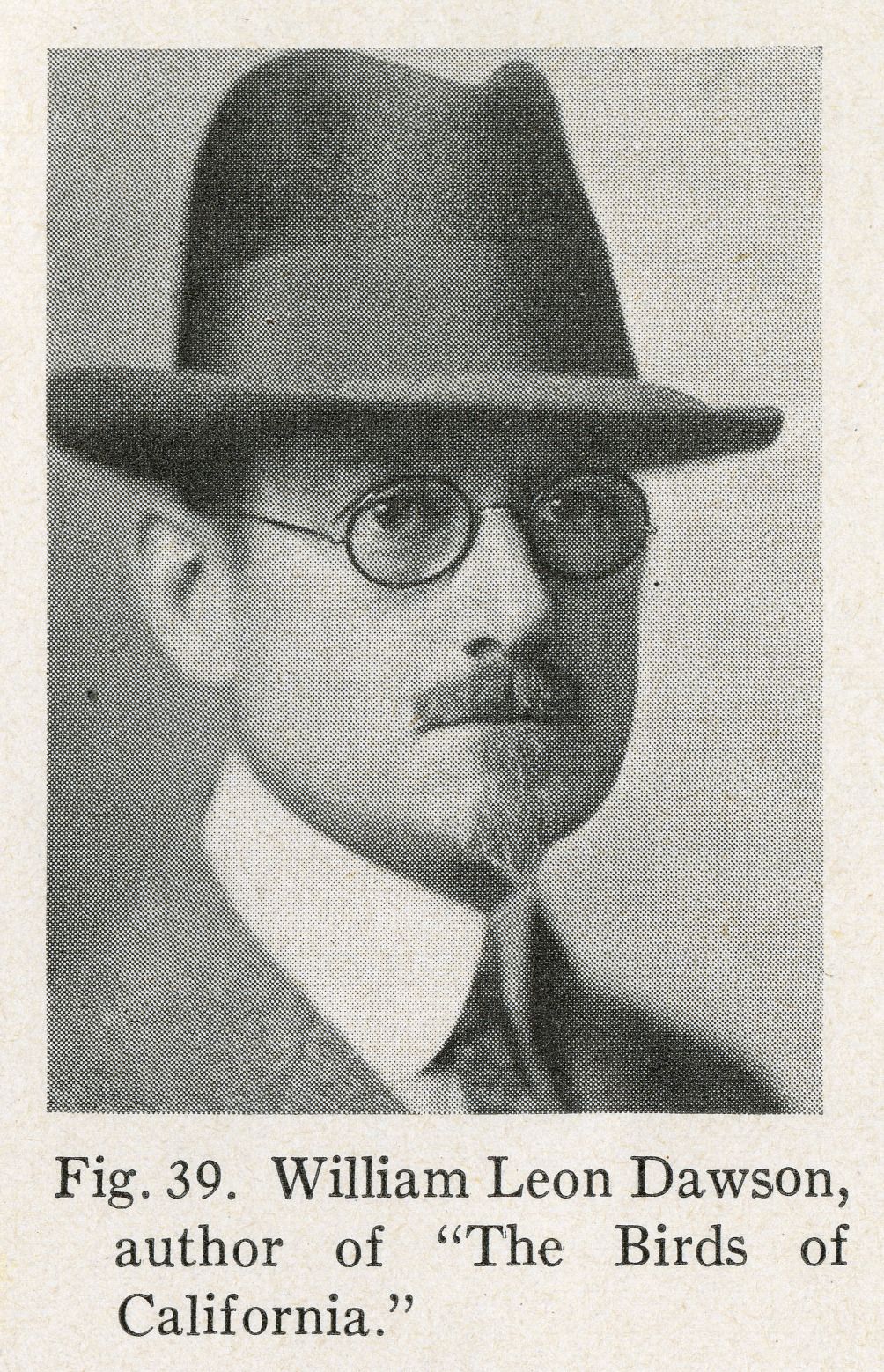
Photo of William Leon Dawson from The Condor.
Photo of William Leon Dawson from The Condor.

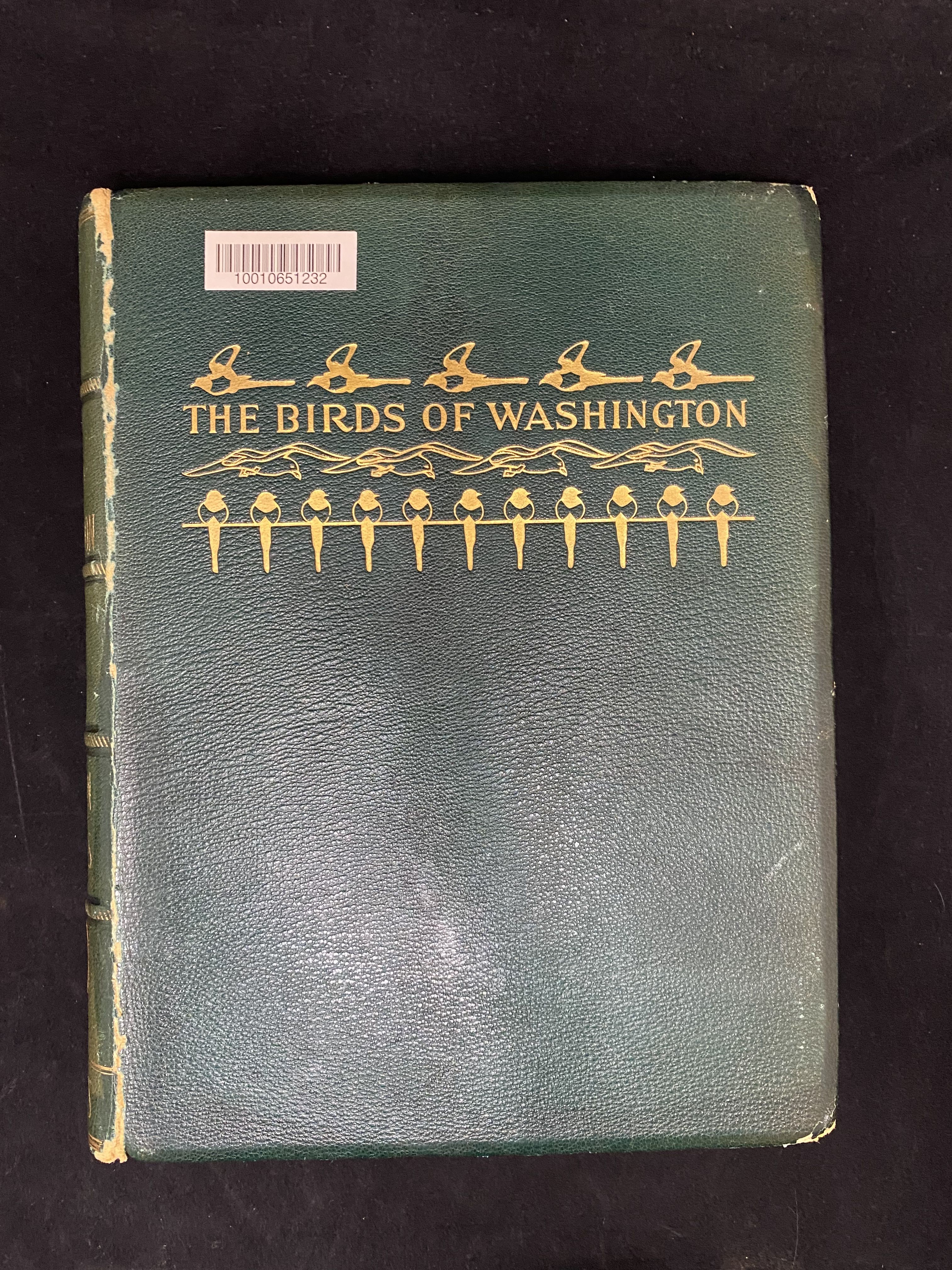
The front cover of Dawson's second "bird book," The Birds of Washington.
The front cover of Dawson's second "bird book," The Birds of Washington.
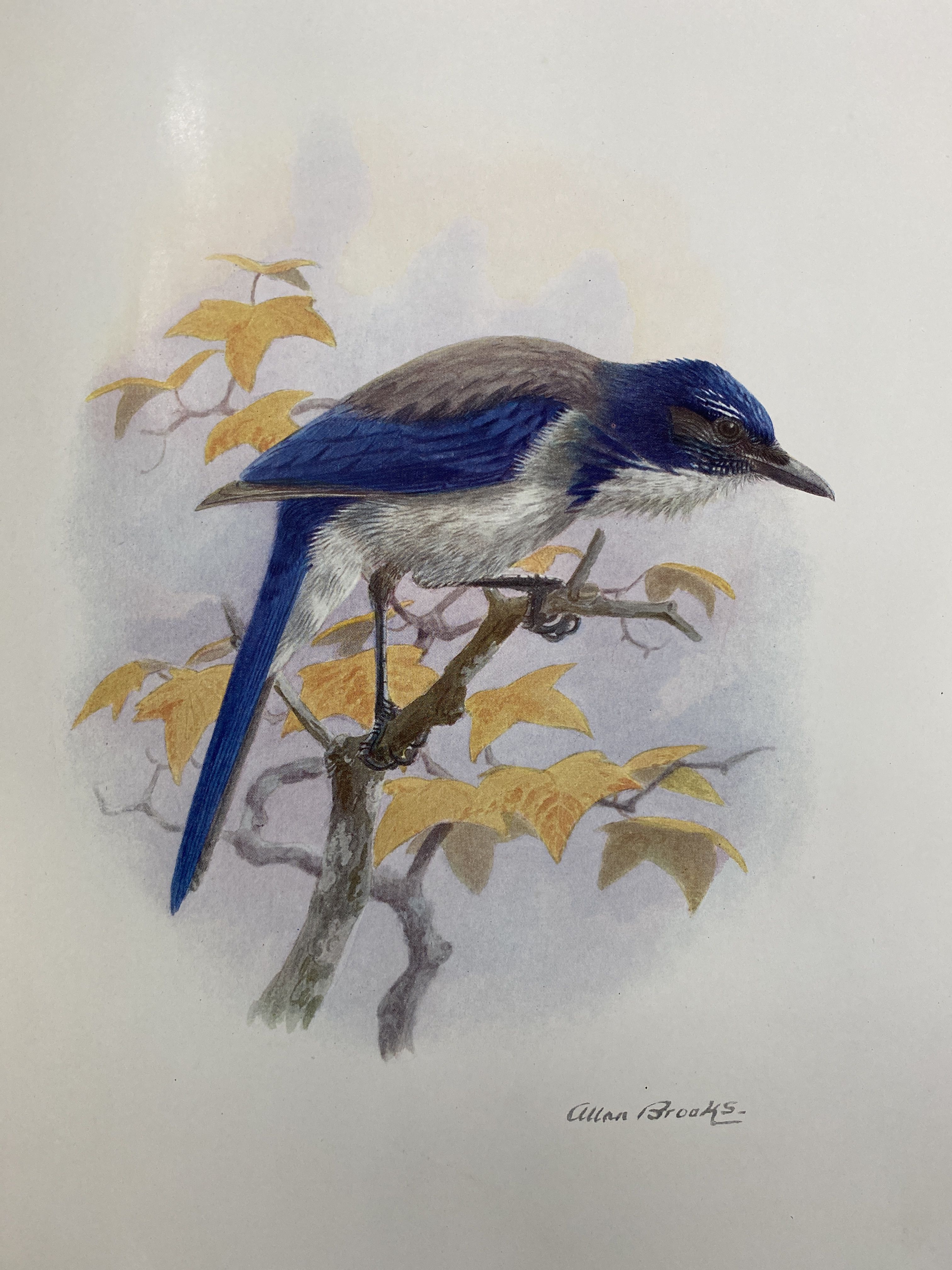
An example of one of Allan Brooks's bird plates made for The Birds of California.
An example of one of Allan Brooks's bird plates made for The Birds of California.

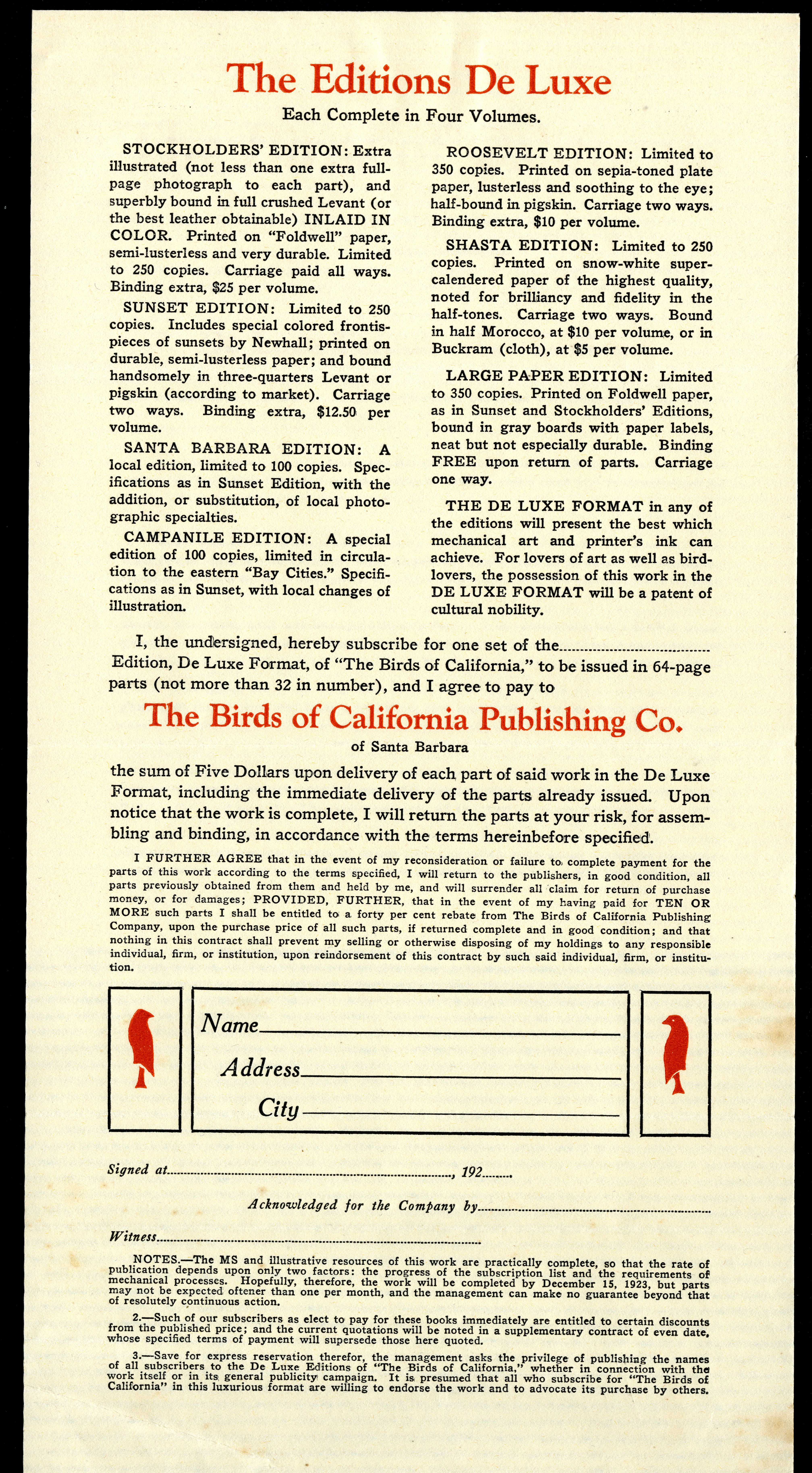
A blank subscription form for the "De Luxe" editions of The Birds of California.
A blank subscription form for the "De Luxe" editions of The Birds of California.

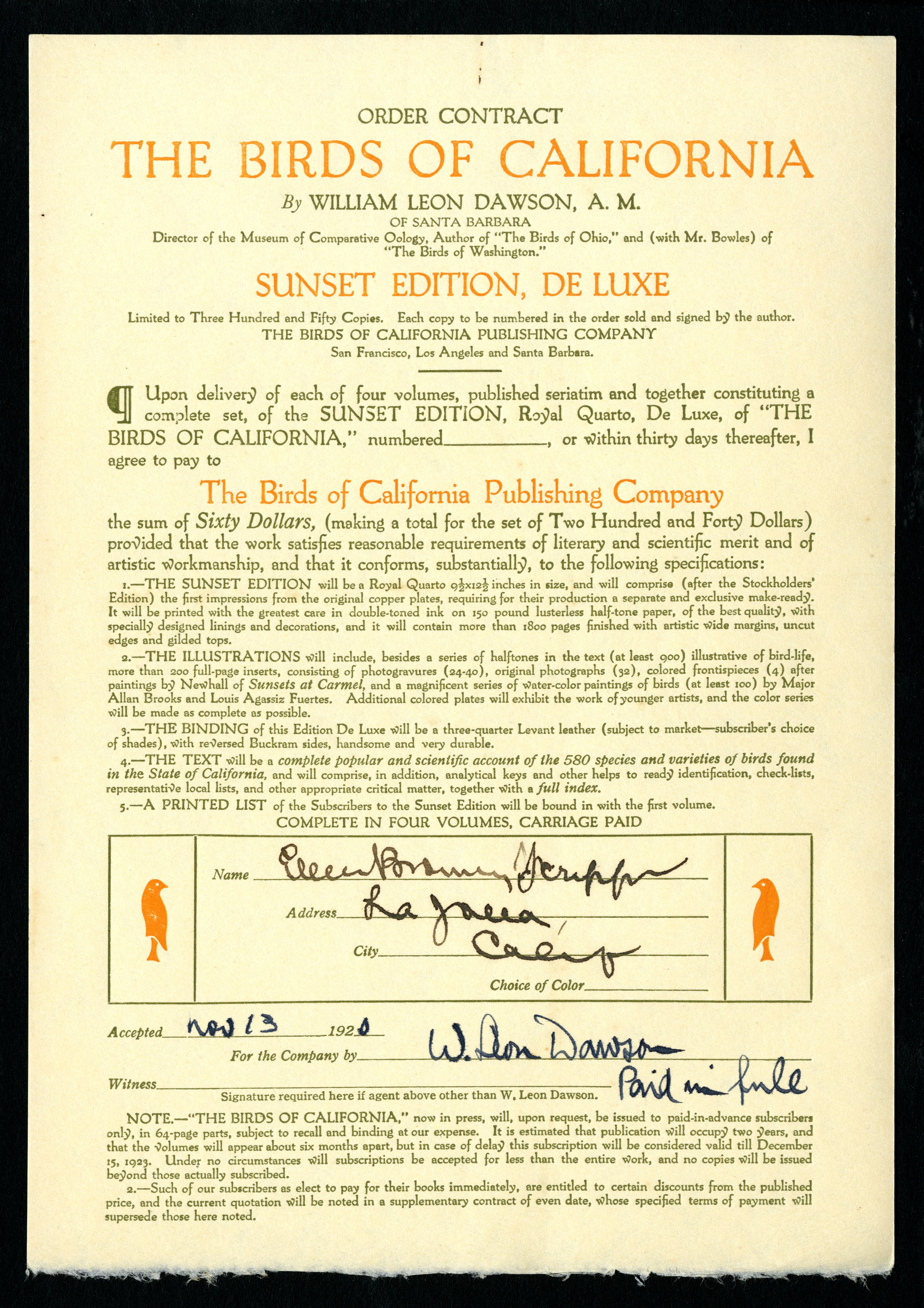
Ellen Browning Scripps's subscription form for the "Sunset Edition De Luxe" of The Birds of California.
Ellen Browning Scripps's subscription form for the "Sunset Edition De Luxe" of The Birds of California.

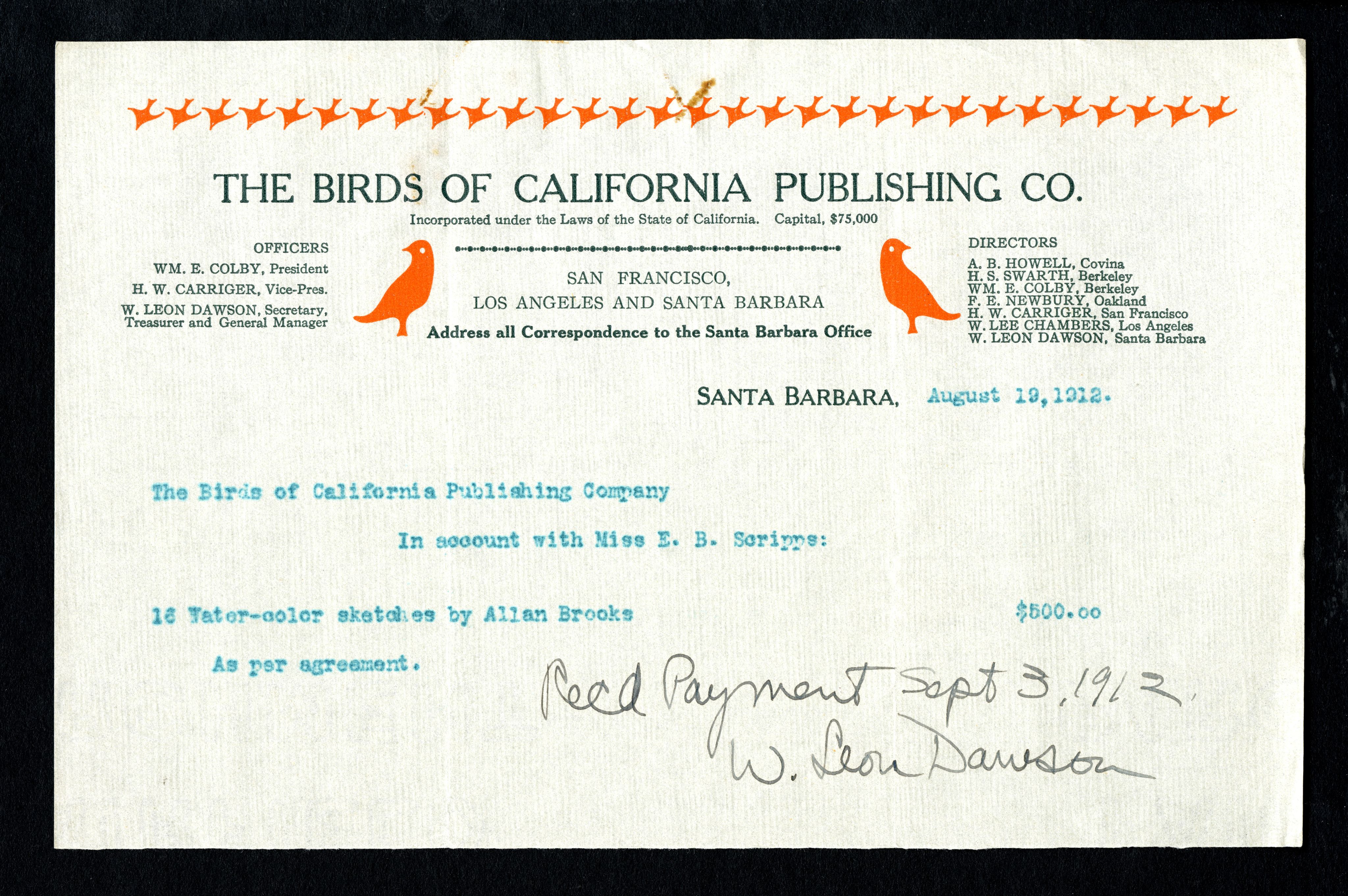
The receipt from Miss Scripps's purchase of extra bird sketches in support of The Birds of California.
The receipt from Miss Scripps's purchase of extra bird sketches in support of The Birds of California.
II. The beginning
In a fashion similar to The Birds of Washington, Dawson created The Birds of California Publishing Company, a company which would handle all the business and financial aspects related to the publication of The Birds of California. Certain patrons of the book who wished to really support the cause could even buy stock in The Birds of California Publishing Company, as a way to donate money to the cause, while retaining some guarantee on investment.
Dawson financed his bird books via a subscription model— parties interested in purchasing a copy would "subscribe" to the book, often before the book was complete. Then, when the book was ready, it would be sent to the subscribers. It was not possible to simply buy a copy from the bookstore.
Dawson was determined to make The Birds of California grander and greater than any of his previous works. The subscription options available for The Birds of California reflected this. He offered multiple models of the work people could subscribe to, from the basic and economical "Student's Edition" to the ultra-deluxe and ultra-pricy "Patron's Edition."
The exact date of introduction between Dawson and Miss Scripps is unknown. But by March 1911, the two had met, and Miss Scripps had agreed to buy a "Patron's Edition" subscription to the forthcoming The Birds of California.
As Dawson began work on the book, his grand visions for it continued to grow, including the desire for even more illustrations in the work than in any prior. To make this happen, he reached out to all subscribers to the Patron's Edition, asking if they would donate money to fund the production of extra color plates illustrated by Brooks, in return for the Patron receiving the original illustration, once the engravers had reproduced it.
Miss Scripps agreed to give extra money, and after a little more back-and-forth, she offered to donate even more money to the project, in exchange for a "super-illustrated" set of books. Dawson delightfully accepted, and assured Miss Scripps of the "pride and fidelity" with which he would "endeavor to fulfill a trust which has become as dear to me as life and honor."
For the next year or so, Dawson continued writing and photographing birds, Brooks continued to paint the plates of the birds, and The Birds of California seemed to continue right on track. Soon, however, things began to get a little more thorny.
III. The troubles begin
In the beginning of 1914, Dawson ran into a what would become a very familiar roadblock: he needed more money. Citing "political uncertainties" and "hard times," Dawson named the amount required as $7500 in a February letter to Miss Scripps. In the same letter, he also asked if he could have "the highest privilege of all" and use Miss Scripps's name on the title page of the book — and also asked the possibility of Miss Scripps donating any further to the project. By March, Miss Scripps had written back to Dawson, consenting to give additional funding of $2500 and for her name to be used.
Despite this respite, the way forward wasn't yet clear. In the summer of 1914, World War I began. In December 1914, Dawson sent out a "Report of Progress" to the stockholders of The Birds of California Publishing Company. While it maintained a positive tone, two important developments were disclosed: Brooks had enlisted in an overseas regiment to fight in WWI, and the provisional publication date for The Birds of California had been set in September 1916 — a date almost two years away, and half a decade since Dawson's announcement of his undertaking of The Birds of California.
1915, by comparison, was relatively quiet. Dawson continued undertaking field expeditions in pursuit of the book, and also commenced plans to open a Museum of Comparative Oology in Santa Barbara at the end of the year.
In August 1916, delay hit The Birds of California once again. Dawson sent out another "Report of Progress" to subscribers, announcing that the publication date would be set back from May 1916 — already two months gone at that point — to, only tentatively, July 1918.
Even after the postponement, however, things still seemed to sour further.

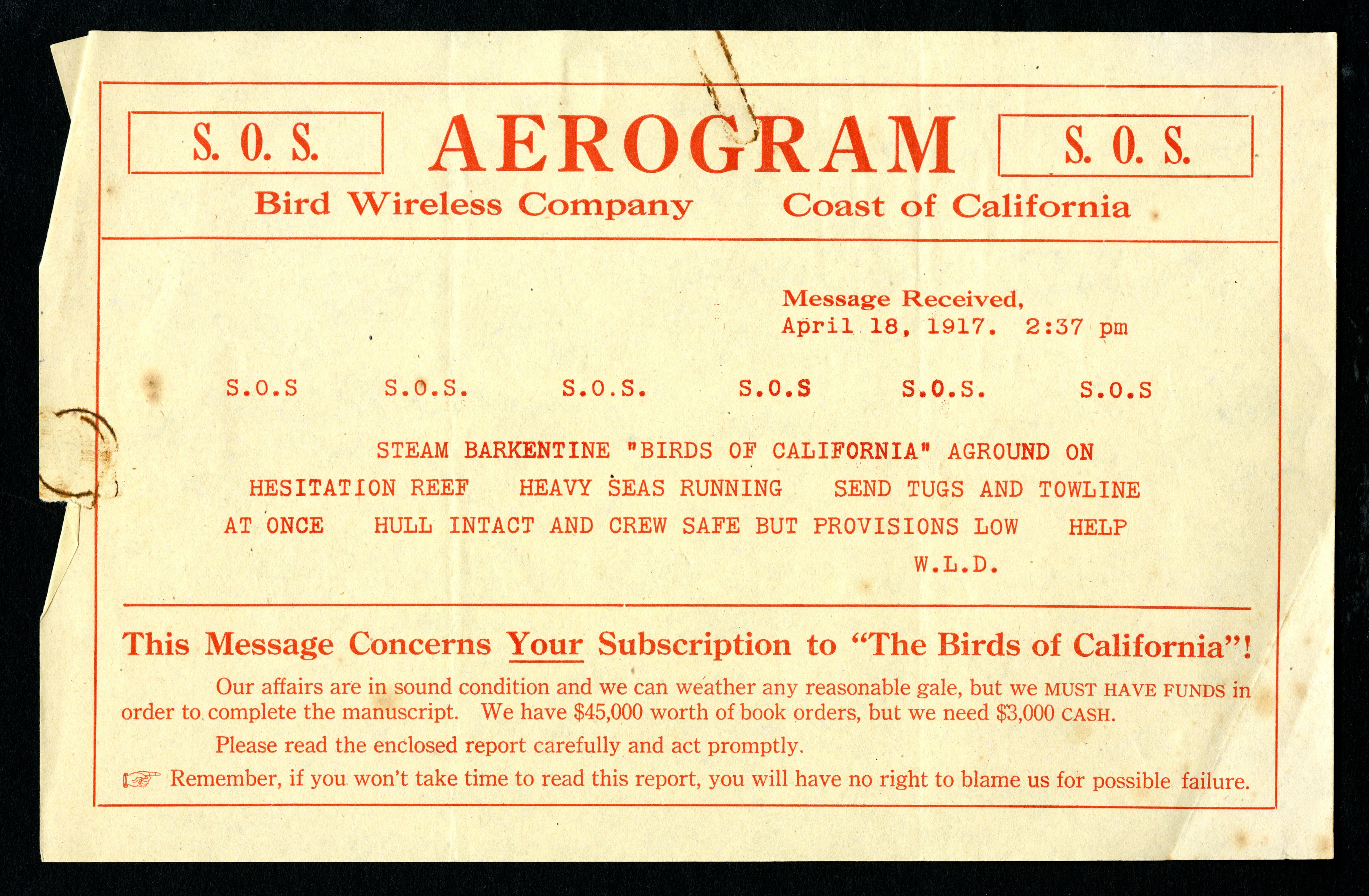
In 1917, Dawson sent out a literal "SOS," citing an urgent need for funds due to a sailing incident.
In 1917, Dawson sent out a literal "SOS," citing an urgent need for funds due to a sailing incident.
Dawson also could no longer resist the patriotic call of World War I and began working for an aircraft company — another diversion from The Birds of California.
1918 and 1919 passed in much the same way. While World War I ended in 1918 and Dawson kept in regular communication with Miss Scripps, there was still no considerable progress made on the book.
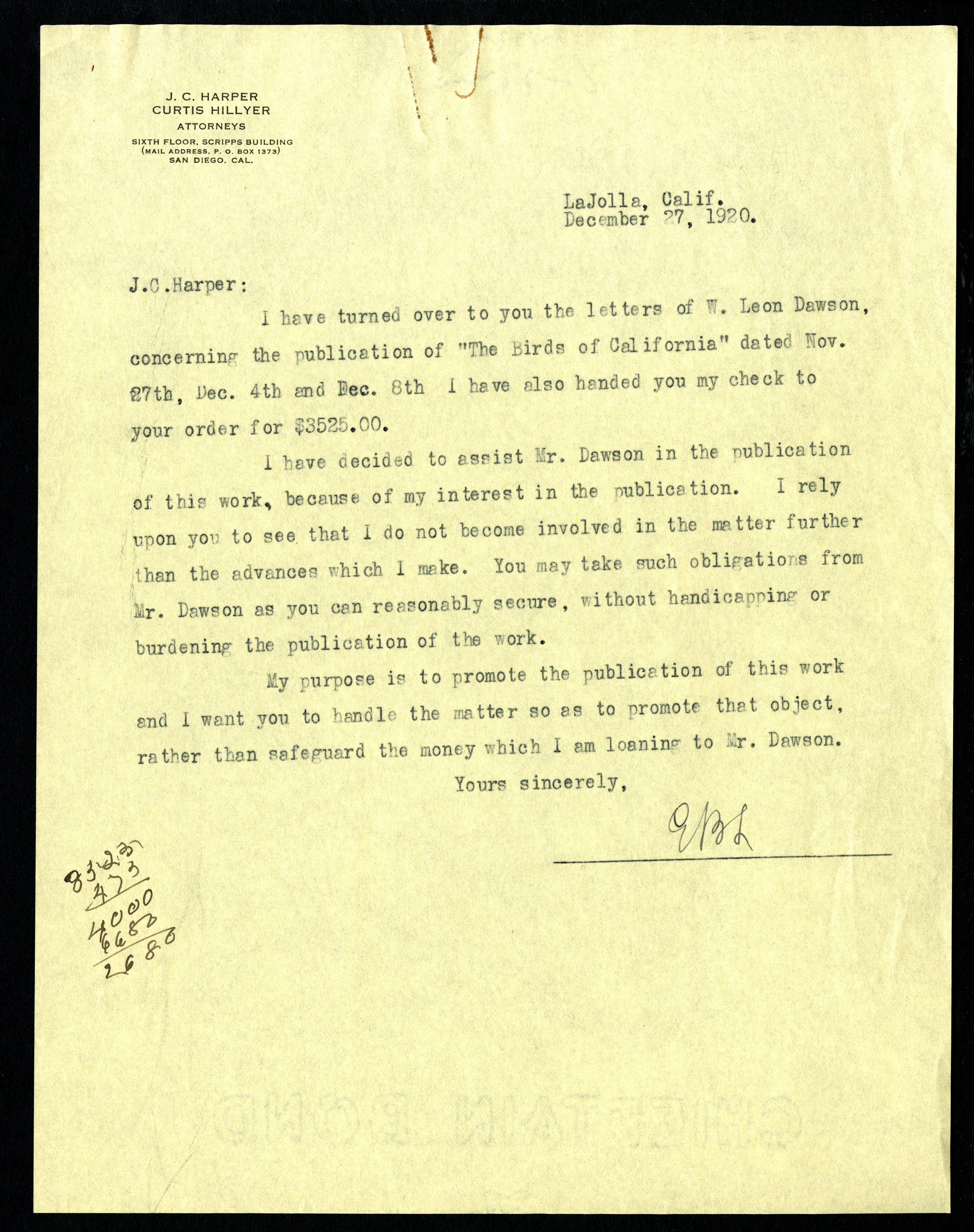
By 1920 — nine years after Dawson and Miss Scripps's initial correspondence, eight years after Miss Scripps had agreed to pledge a little extra money, and four years after The Birds of California was originally meant to be published — it seems Miss Scripps wanted some additional help with the matter of The Birds of California. She sent a note to J.C. Harper, her longtime attorney, asking him "to handle the matter" from then on. This was a move that would change the dynamic forever.
IV. Harper enters the scene

J.C. Harper was a 62 year old man who had been working generally with the Scripps family for at least 12 years, and he had been a close associate of Ellen Browning Scripps's for almost as long. A judge, he had a no-nonsense reputation and was exceedingly loyal to Miss Scripps.

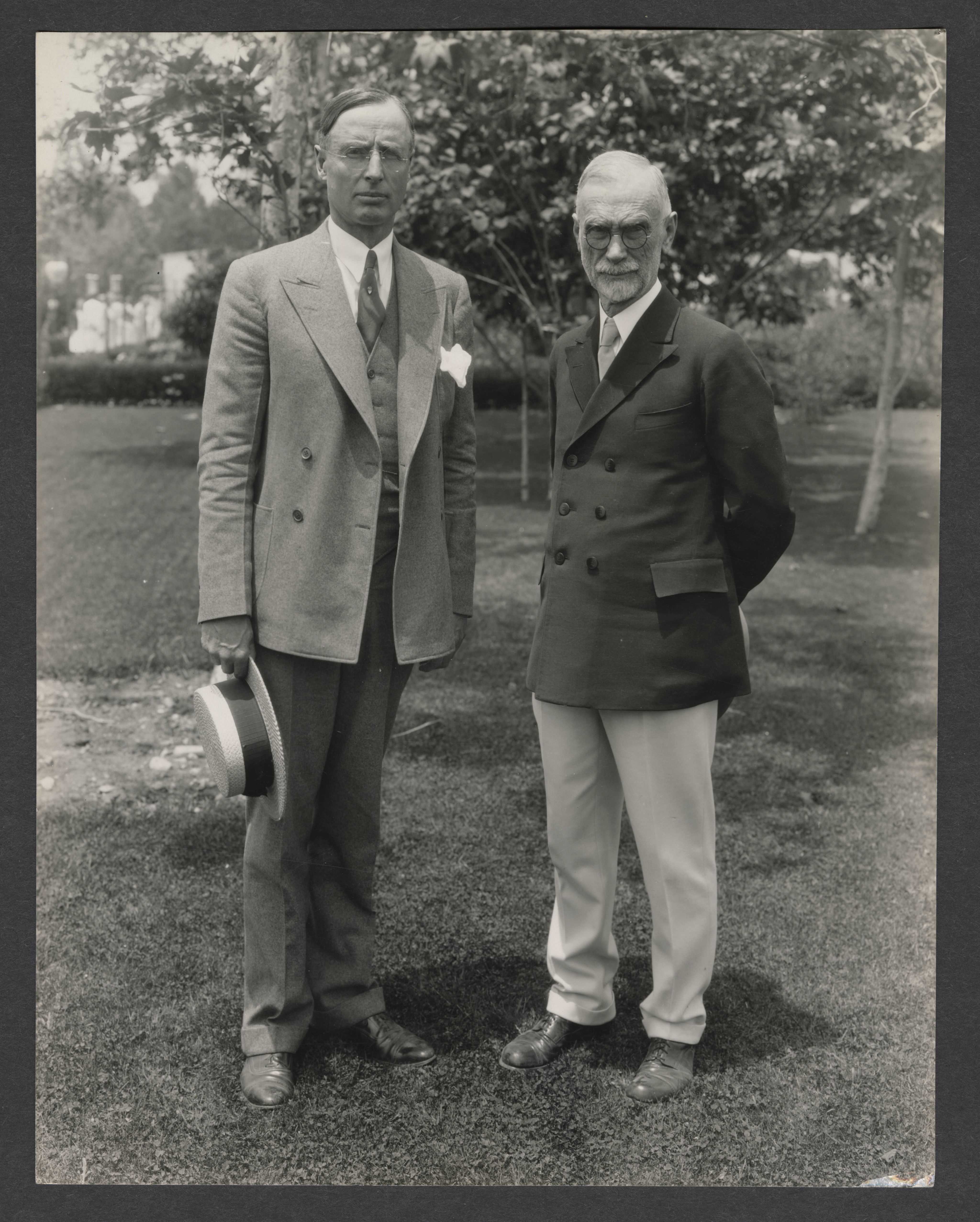
J.C. Harper (right) stands with Ernest Jacqua (left) at Scripps College.
J.C. Harper (right) stands with Ernest Jacqua (left) at Scripps College.
When Miss Scripps asked Harper to helm The Birds of California from that point forward, that was no simple request. By 1920, Miss Scripps had invested thousands into the project, and the expected publication dates and future funding required remained murky.
In January 1921, Harper sent Dawson $2500, which was meant to ensure the publication of parts one and two of The Birds of California, without any other delays. In a friendly gesture, Harper also asked Dawson to include him among the subscribers.
A month later, Harper wrote to Dawson again with inquires as to the overall financial state of The Birds of California, in order to aide its publication and ensure Miss Scripps's financial obligations were protected. Harper also let Dawson know that he believed Miss Scripps wanted further communication about The Birds of California to be sent to Harper, in order to allow Miss Scripps to conserve her energy as she entered her 85th year.
In April, Dawson – ignoring Harper — sent a letter to Miss Scripps containing perhaps the biggest request yet of their time together: he asked Miss Scripps to entirely fund the publication of The Birds of California.
"I venture to believe that it would be a beautiful and monumental human service if Miss Scripps were to provide in full for the publication of such a work as 'The Birds of California', and to leave it as a legacy to her fellow-men."
Miss Scripps did not respond to Dawson's large ask, but rather forwarded Dawson's letter to Harper and expressed her interest in the project but lack of decision as to further steps.
In July, having not yet replied to Dawson's proposal, Harper sounded the alarm bell to Miss Scripps, telling her of "the utter unreliability of Mr. Dawson's estimates" and Harper's fear that Miss Scripps would be involved in not only large financial liability but also in serious losses.
It wasn't until September that Harper made an "official" recommendation to Miss Scripps as to what her further course of action in regard to The Birds of California should be, however: he told her that he believed she should have no further involvement with Dawson and The Birds of California beyond what she had already given.
In that same month, Curtis Hillyer, another attorney working for Miss Scripps, conducted independent research, without input from Dawson, as to how much it would truly take to bring The Birds of California to fruition; he concluded it would take about $100,000 to reach this goal.
After learning this information from her lawyers, Miss Scripps made her decision as to her next steps with The Birds of California.
At the end of September 1921, 10 years after her first donation to the project, Harper wrote to Dawson to tell him of the decision.
Miss Scripps had decided to give no further funding to The Birds of California.
V. The fallout
Dawson did not take this decision very well, as The Birds of California represented his deepest of passion projects.
To that end, in October, he wrote back to Harper and Miss Scripps with some scathing letters. In a letter sent to Miss Scripps, he accused Harper and Hillyer of deliberately interfering and conspiring to thwart him and his efforts to publish The Birds of California, without Miss Scripps's knowledge. In a nine page letter sent to Harper, he also threatened legal action against Miss Scripps and/or her estate, in order to get the money.
Miss Scripps responded to Dawson's in short manner; she told him that she was no convinced "of the futility of any further personal negotiations of correspondence between us" and reiterated that from now on, she wished Dawson to send all communication to Harper.
Harper responded to Dawson's letter with matching vigor, declaring that Miss Scripps had no legal or moral stake in ensuring The Birds of California is published, and that Miss Scripps still desired to not give any more money to the project.
Dawson did not let Harper's letter dissuade him, however. He wrote back an impassioned letter stating that Miss Scripps, did, in fact, have a legal and moral stake in the matter, and that Dawson was the only person restraining unspecified important people and large groups from "expressions of condemnation of Miss Scripps." Dawson laid it all on the line and proceeded to ask for more money from Miss Scripps and/or her estate to once and for all ensure the publication of The Birds of California.
Excerpt of the letter sent to J. C. Harper by William Leon Dawson in October 1921.
Dawson's plea seemed to have some effect. At the very end of the month, Hillyer wrote back to Dawson, offering $3000, and absolutely no more, as authorized by Miss Scripps. A sum considerably smaller than the estimated $100,000 estimated by Hillyer required to actually publish the books, it nonetheless represented a life ring for Dawson amid the stormy waters of The Birds of California.
VI. The interlude
Despite her edict to no longer give any funding to The Birds of California, the topic appeared to still be on Miss Scripps's mind almost a year later in August 1922. In a letter to her from Harper, the attorney re-expressed his belief she has given more than her fair share to the project and highlighted their shared sentiment that "Dawson as a business man is utterly impossible."
However, he also gave her some preliminary numbers for the cost of publishing the books, in acknowledgment of her indication that she "might go ahead with the matter in [her] lifetime."
In further pursuit of supporting The Birds of California's seeing the light of day, Hillyer again researched the practicalities required support it. He suggested to Miss Scripps, that if she was committed to seeing the project through, she should create a new publishing company to publish The Birds of California, in order to streamline the process and protect her financially and legally as much as possible. In this new company, Dawson would not be allowed anywhere near the business side — he would be retained in a strictly editorial role.
Miss Scripps eventually decided to go through with this undertaking, and by 1923, the South Moulton Publishing Company was born, with Hillyer overseeing the day-to-day and managerial aspects of the company.

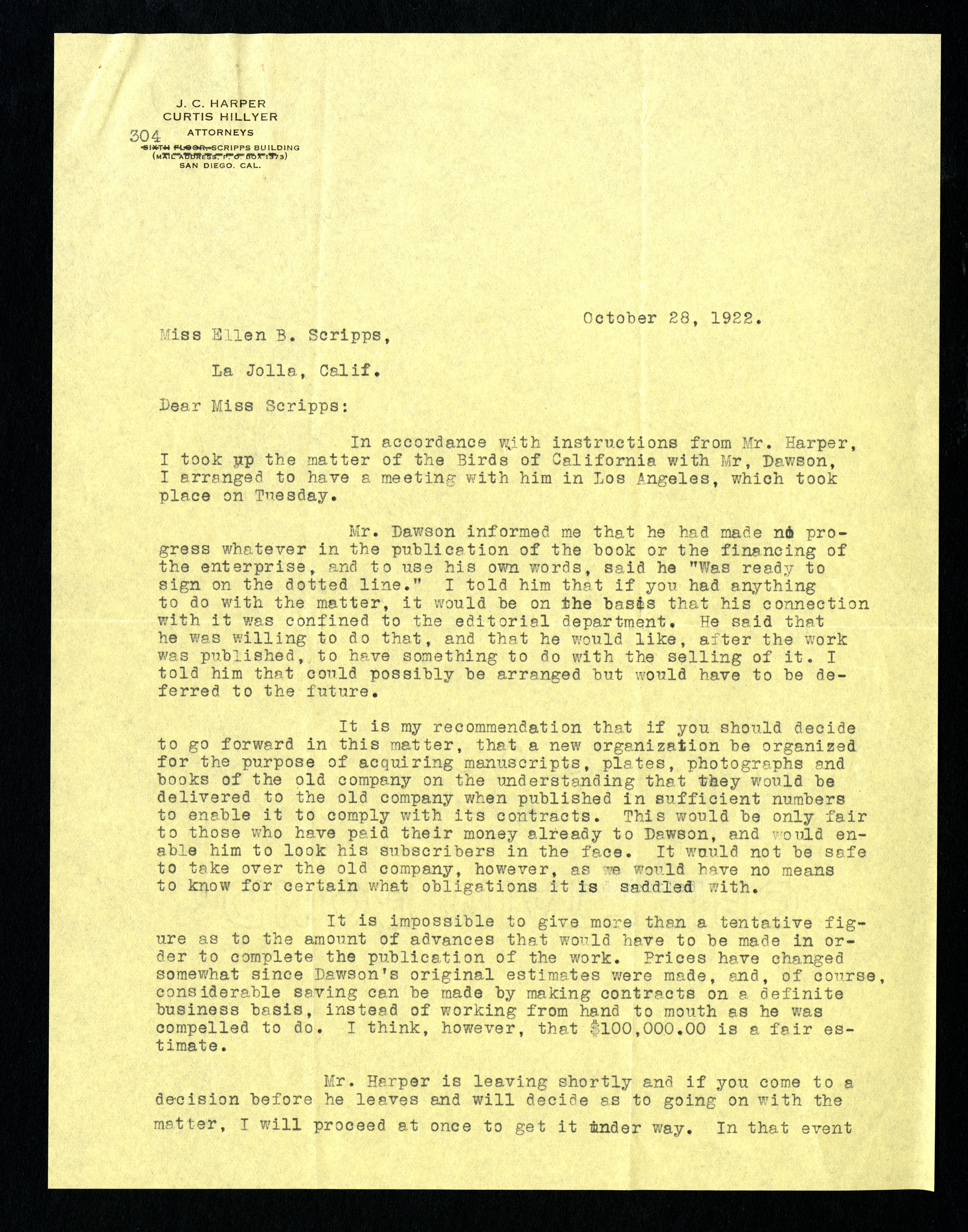
Hillyer's letter in 1922 to Miss Scripps suggesting that it would cost around $100,000 to actually publish The Birds of California.
Hillyer's letter in 1922 to Miss Scripps suggesting that it would cost around $100,000 to actually publish The Birds of California.

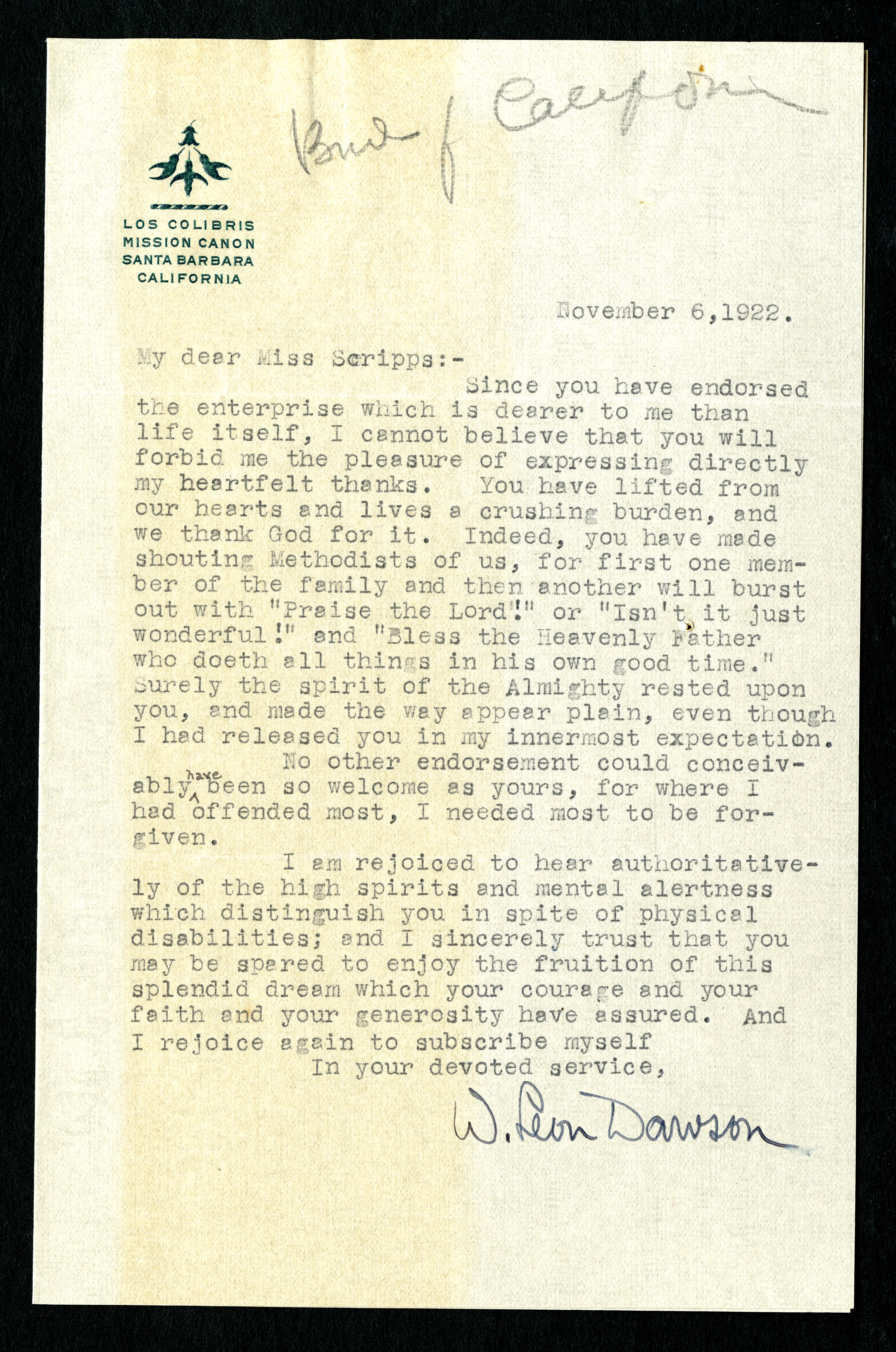
Dawson's thank you note to Miss Scripps sent after her announcement that she would provide for the publication of The Birds of California.
Dawson's thank you note to Miss Scripps sent after her announcement that she would provide for the publication of The Birds of California.

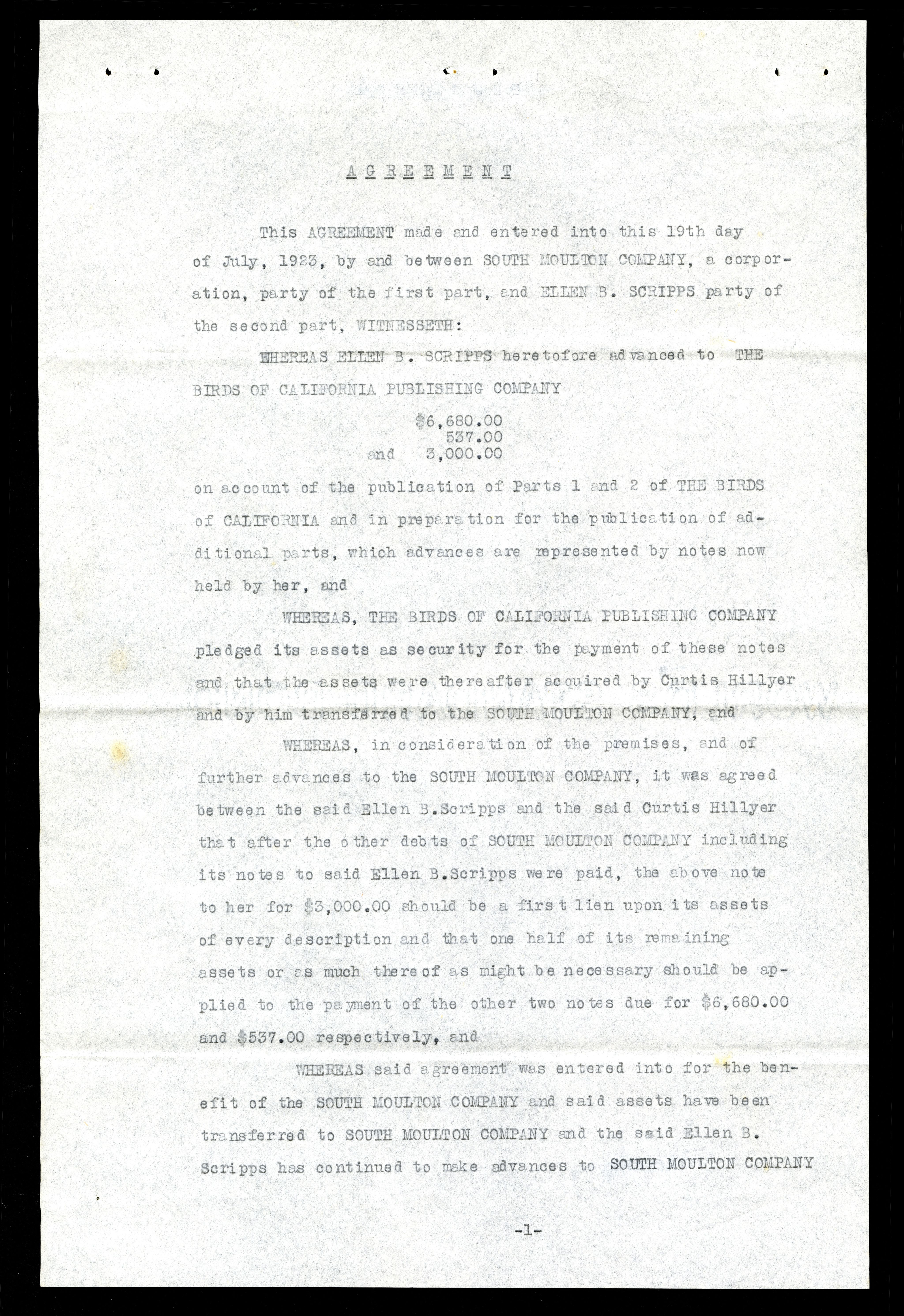
First page of an official agreement entered between the South Moulton Company and Ellen Browning Scripps regarding her financial contributions to The Birds of California.
First page of an official agreement entered between the South Moulton Company and Ellen Browning Scripps regarding her financial contributions to The Birds of California.
VII. Dawson sidelined
True to Miss Scripps's vision, under the new South Moulton Company, Dawson worked solely on the manuscript, before becoming the sales manager after the manuscript was complete. However, that wasn't the end of their tenuous relationship.
In April 1924, Dawson was let go of as sales manager, and he wrote to Miss Scripps contesting the decision, claiming he was never given the chance to fully exercise his selling abilities.
Dawson wrote again in July complaining about the lack of royalties received by him from the sales of the book, and he asked her to clarify her role in relation to the South Moulton Company. He also threatened that while he did not want to target her, he was unafraid to take legal action against the company, if it should prove necessary.
Harper was the one to reply to this message, telling Dawson that Miss Scripps's sole connection to the project at that point was as creditor, and that the project never would have come to fruition if Hillyer hadn't stepped in to help (on Miss Scripps's behalf, of course).
Dawson appeared mollified for the time being. In October 1925, however, things reached a sticking point.
Dawson wrote a two page letter to Miss Scripps, containing a scathing recap of the injustice he felt had been done to him in the process of the publication of The Birds of California, placing much of the blame on Hillyer and his control of the South Moulton Company, as well as Harper. Further expounding on the injury afforded to him by his dismissal form the South Moulton Company, he asked her:
"Forbidden to help with the sales, I am being dragged down, willy nilly, into the depths of a hopeless poverty. To what end? Is this a punishment for my 'sins' of independent judgment? Or are your attorneys serving ends of their own? Or is it sheer stupidity upon their part? Bungling mismanagement?"
In the same letter, he also said that everything he had done in the past 13 years had been "with an honest heart" and meant to serve her."
Harper responded on behalf of Miss Scripps — and he was not happy. He said that no longer would anyone make the mistake of working with Dawson, due to the "futility and danger of trying to assist" him.
In response to Harper's letter, Mrs. Dawson wrote back to Harper, defending her husband and his actions in the publication of The Birds of California, and sent a copy of that letter directly to Miss Scripps as well.
Miss Scripps responded to Mrs. Dawson's letter in one of the last communications recorded between the Dawson and Scripps parties.
Miss Scripps kept it relatively short and sweet, saying that she was sorry that both she and Mrs. Dawson had been drawn into the matter, and that by the end of their working relationship, she truly believed that The Birds of California could never be published as long as it was helmed by Mr. Dawson. And to date, that was the last communication between Dawson and Miss Scripps for many years, until Mr. Dawson died in 1928.
And so ultimately, Dawson died without ever making up with Miss Scripps — but also, he died with his ultimate bird book dream realized.

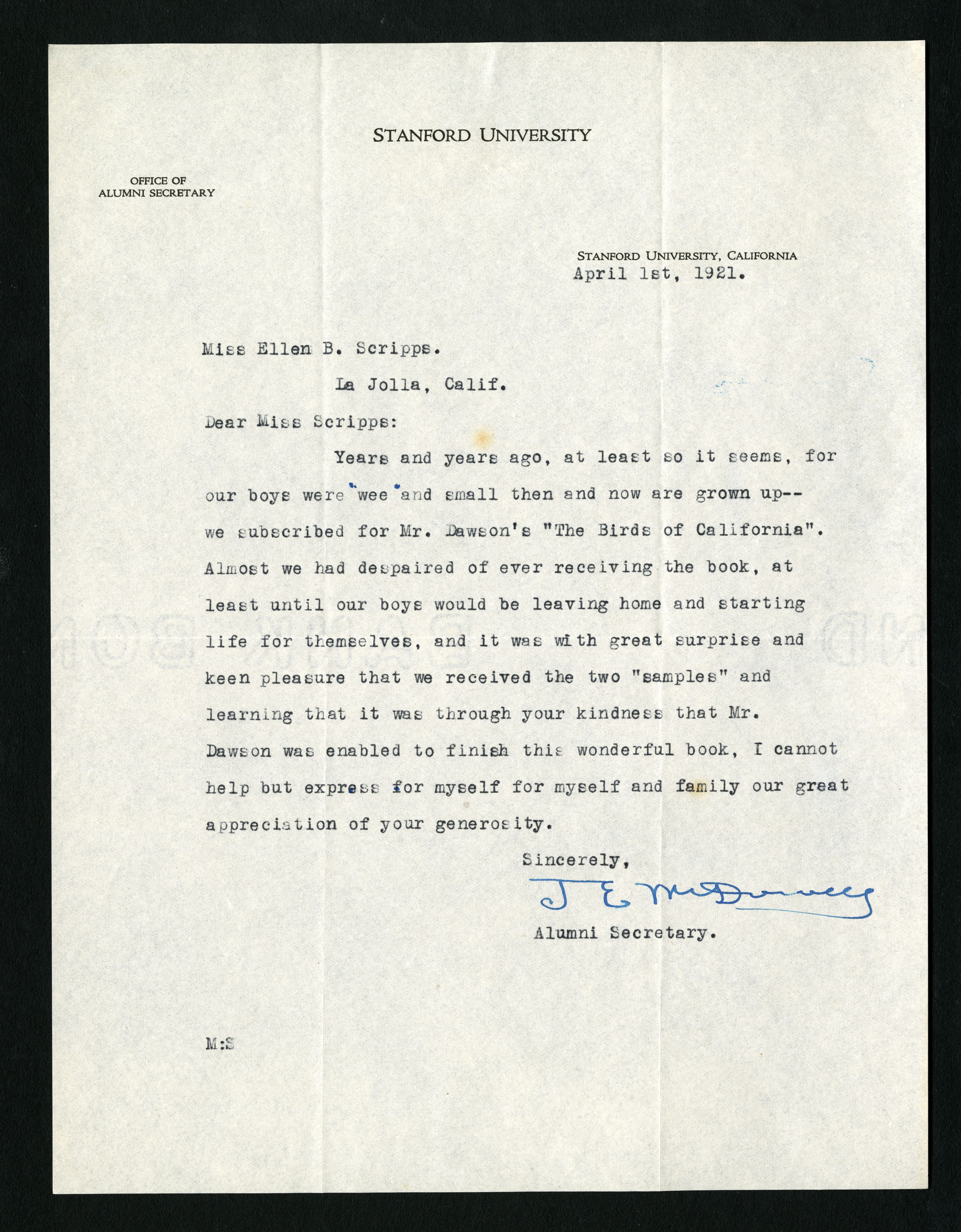
Thank you note from J. E. McDowell for The Birds of California, with a lighthearted anecdote about her family in the time before its publication.
Thank you note from J. E. McDowell for The Birds of California, with a lighthearted anecdote about her family in the time before its publication.

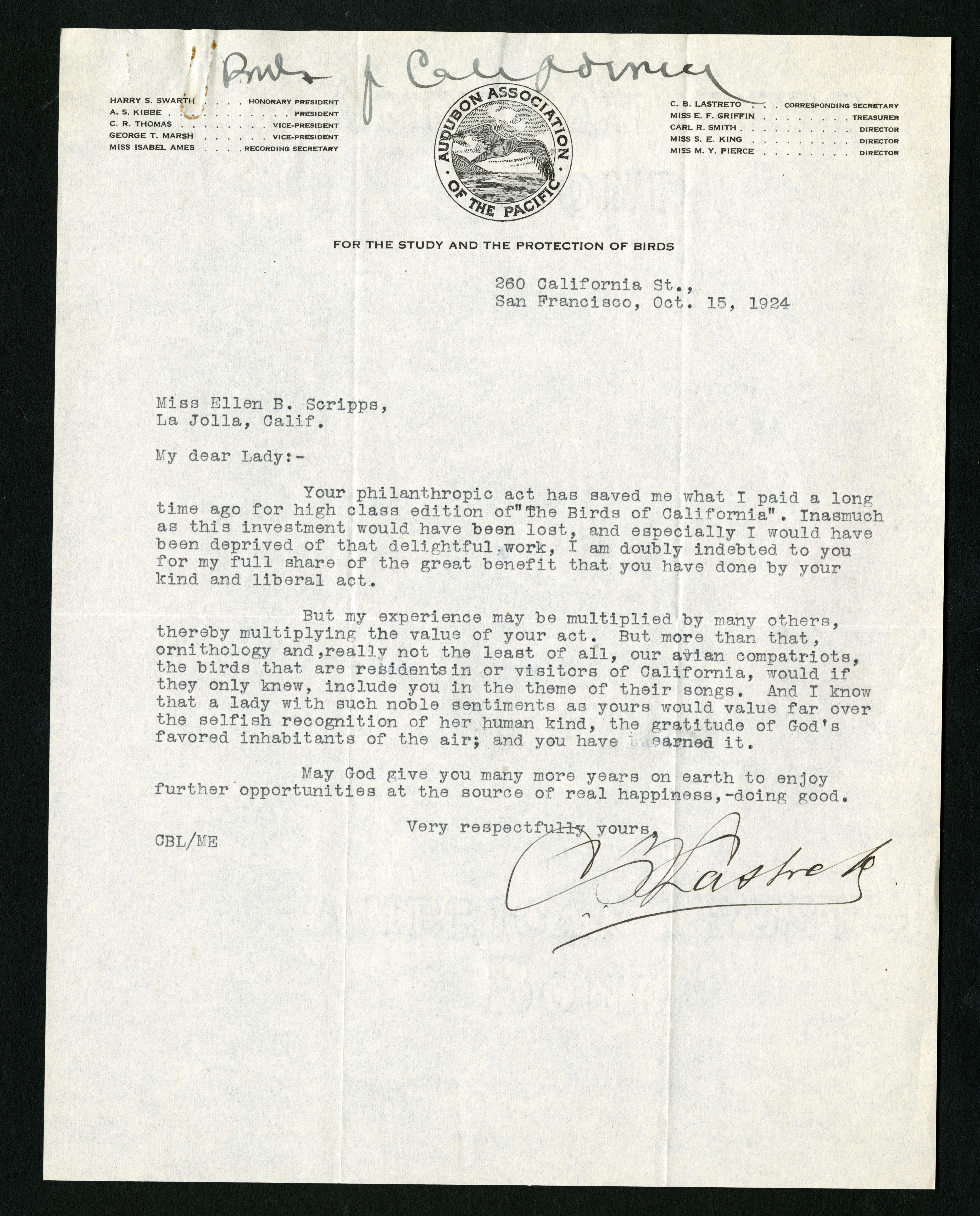
Thank you note from C. B. Lastreto of the Audubon Association of the Pacific for The Birds of California.
Thank you note from C. B. Lastreto of the Audubon Association of the Pacific for The Birds of California.
VIII. Books, received
As the book (finally) began to be sent to subscribers in 1923 and 1924 — many of whow waited over a decade for the book — gratitude and praise began rolling in.
Many wrote directly to Miss Scripps to tell her how thankful they were that she became involved in the project and her efforts towards seeing it published. A Mr. Wood wrote to Miss Scripps telling her of his conviction that "In spite of the many intrinsic excellencies of the volumes we feel that, despite Mr. Dawson's heroic efforts to place it before us, most of his work wd. never have seen the light but for your timely assistance"
Others were less diplomatic in their praise.
"You are probably aware of the fact that Mr. Dawson's enterprise was hopelessly lost and would never have appeared but for Miss Ellen B. Scripps of La Jolla, Calif." said W. Lee Chambers, Business Manager of the Cooper Ornithological Club, in a letter to members urging them to write "the dear old lady" their thanks for her work in publishing The Birds of California.
However, despite the discussions around the process to getting the work published, praise and admiration for the quality of the books was nigh-universal. One Miss Miller said: "Of the work itself – I shall never regret the $185. paid – for it is beyond all praise. I never dreamed of such a superb descriptive history of Birds; and the colored plates! Well, you just feel you must stroke the feathers."
Theodore J. Hoover, the president of Stanford University at the time, also sent his thanks: "Scientific men generally and the Cooper Ornithological Club in particular owe you their gratitude and thanks," he wrote to her.
It wasn't all smooth sailing after getting the books out to the original subscribers, however. Though the books received immense praise, Hillyer, as de facto sales manager of the South Moulton Company, soon ran into a problem while selling them: while the books were beautiful, they attracted a very niche clientele. And much of this clientele had already been exposed to the books.
Eventually, in 1927, Harper wrote to Hillyer about how, on account of "the affairs of the South Moulton Company have been going from bad to worse for over two years," it would be better for Miss Scripps for them to dissolve the company and take the loss, rather than keep the company going. Hillyer agreed.
At this point in time, the extra copies of The Birds of California were simply sitting around in storage at Pomona College. When faced with the question of what to do with them, Miss Scripps distinctly made it known that she did not wish for them to be destroyed or thrown away.
These are the places she eventually had them go to:
California high schools and junior colleges

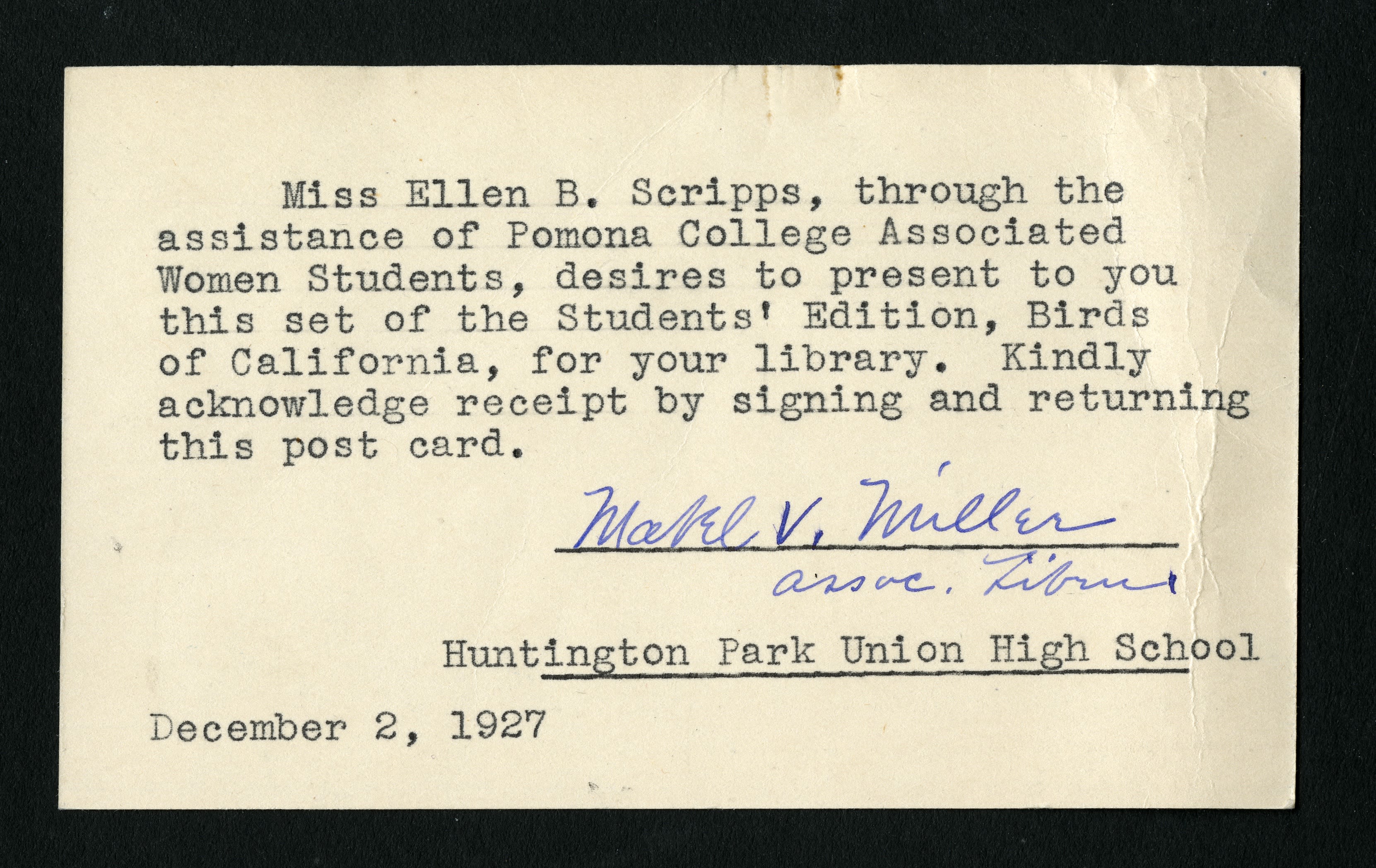
Example of a card sent out with every copy of The Birds of California gifted by Miss Scripps to high schools and junior colleges in California.
Example of a card sent out with every copy of The Birds of California gifted by Miss Scripps to high schools and junior colleges in California.
In a particularly generous edict, Miss Scripps wrote to Harper telling him, "It is my wish that a copy of the Students Edition of the 'Birds of California' be be given to the Junior Colleges and High Schools in California."
And so, true to her word, copies were sent out to junior colleges and high schools in California. Miss Scripps received an influx of thank you notes from the schools, noting the students' appreciation for such lovely, comprehensive books.

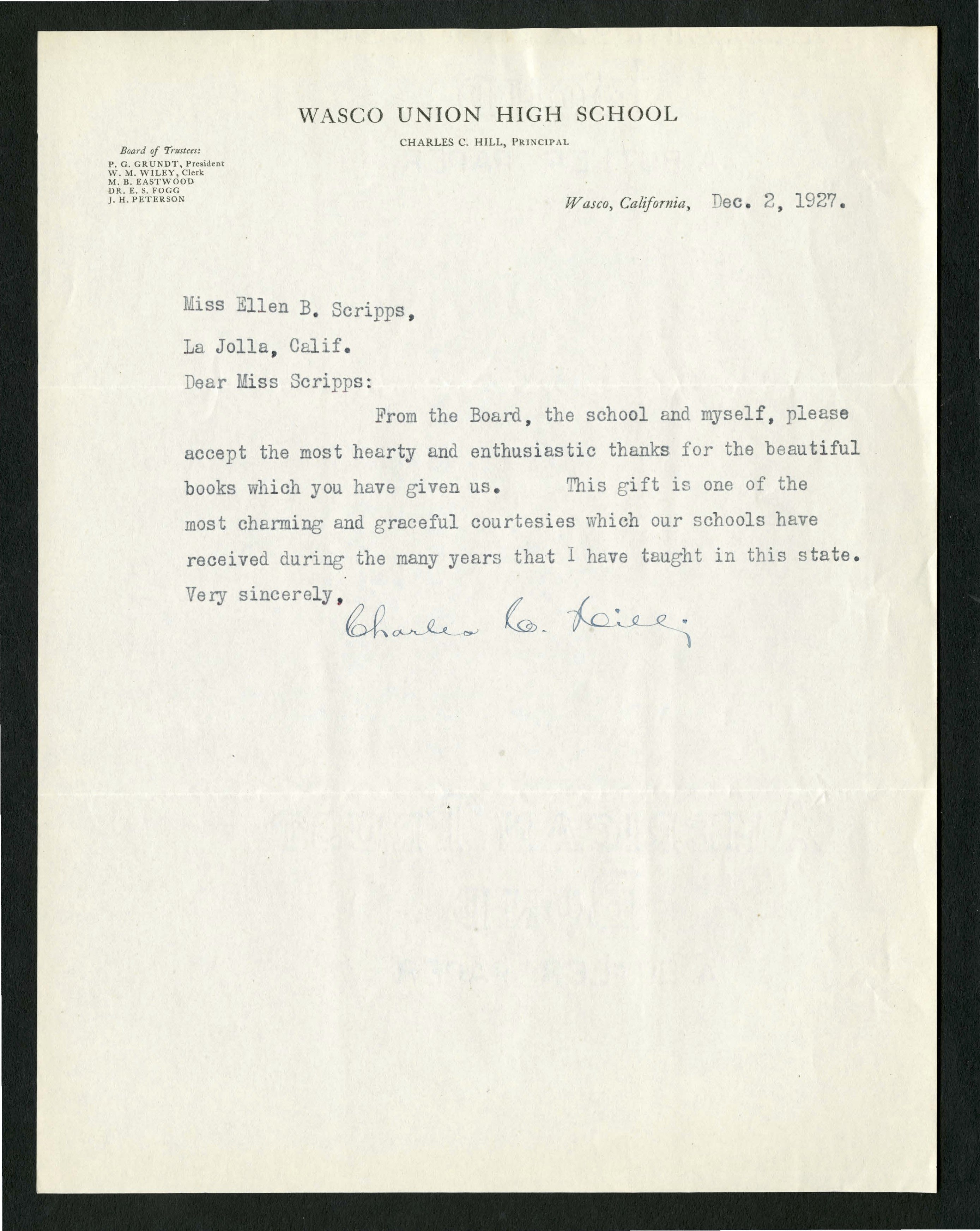
A thank you note from Wasco Union High School to Miss Scripps for her donation of a set of The Birds of California.
A thank you note from Wasco Union High School to Miss Scripps for her donation of a set of The Birds of California.
National and international universities

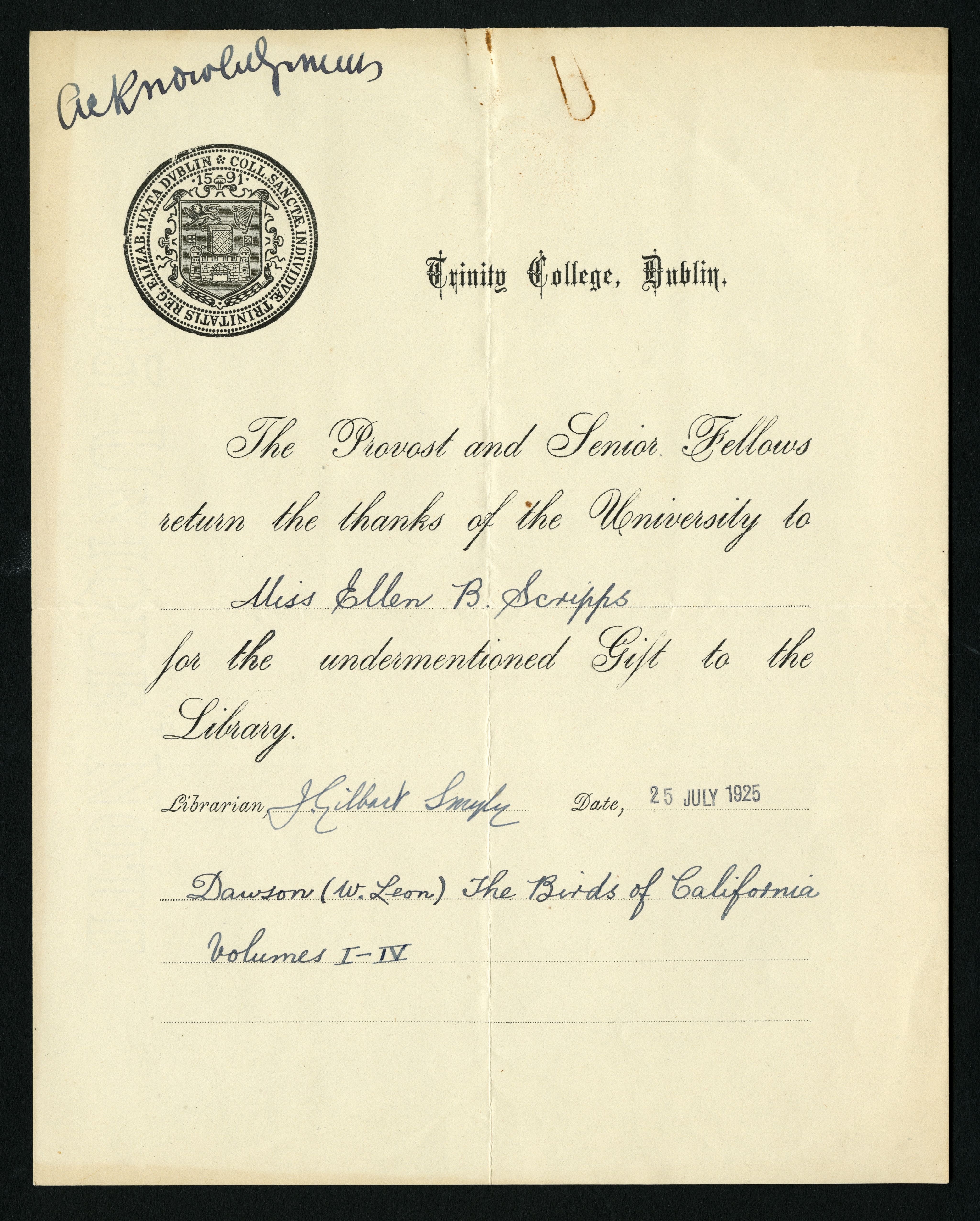
Thank you note from Trinity College, Dublin, for Miss Scripps, acknowledging her donation of The Birds of California to their library.
Thank you note from Trinity College, Dublin, for Miss Scripps, acknowledging her donation of The Birds of California to their library.
In 1925, Miss Scripps began gifting universities copies. In March, she had a copy sent to the nearby University of Southern California. In May, Miss Scripps wrote to Hillyer and asked that copy of The Birds of California be sent to ten different European universities — including Cambridge, Oxford, and Trinity College, Dublin — on her dime.
In 1927, facing the prospect of still having extra copies, she sent off sets to other universities, including Mills College, Berkeley, Oberlin, and even Lingnan University in China.

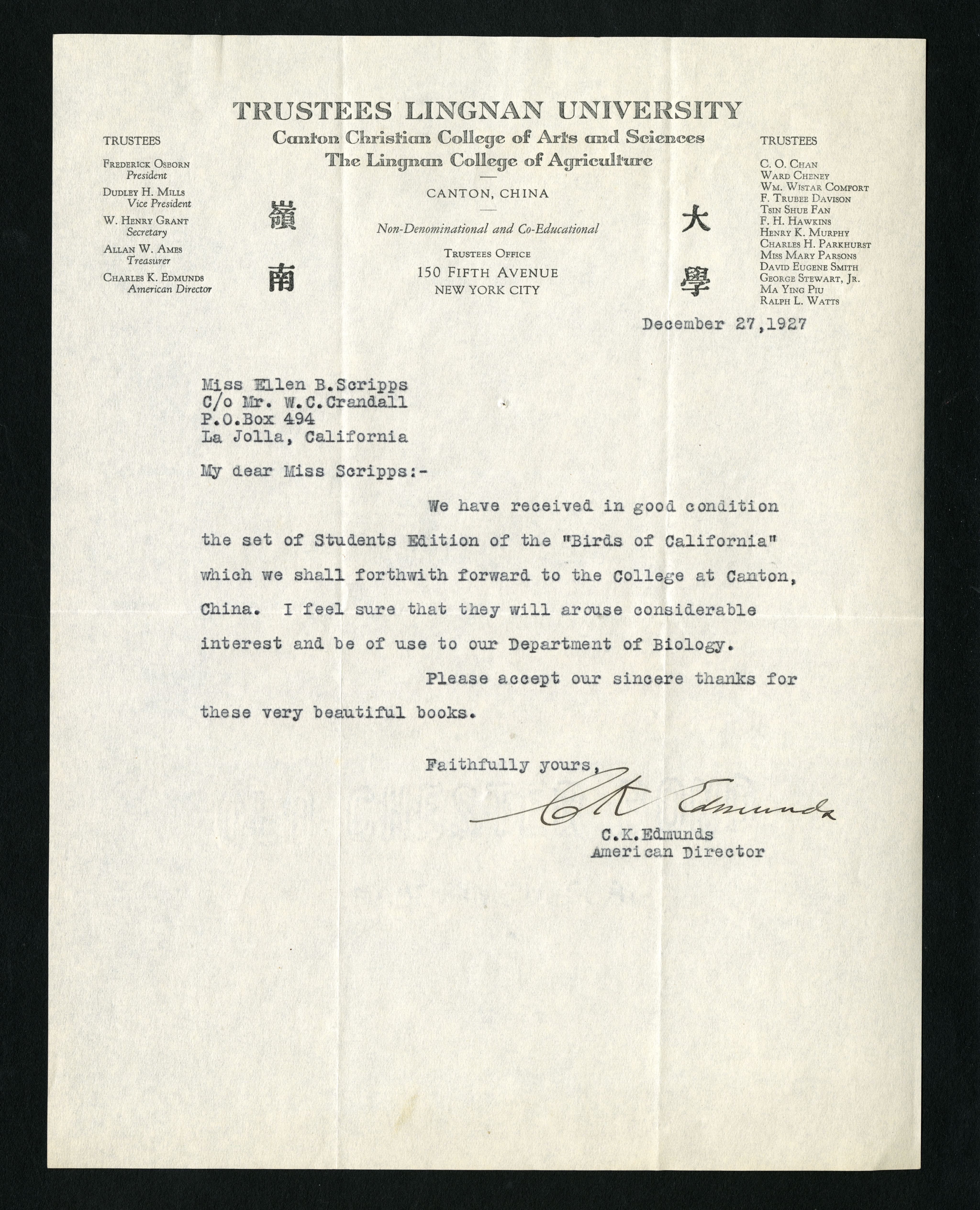
Thank you note from Lingnan University in China for their copy of The Birds of California.
Thank you note from Lingnan University in China for their copy of The Birds of California.
 Built with Shorthand